%20Image%20Q_new.jpg?tr=w-1800%2Ch-1132)
Types of Questions on the Canadian Virtual OSCE

I. Introduction
The Virtual OSCE (Objective Structured Clinical Examination) administered by the National Dental Examining Board of Canada (NDEB) is a summative examination required for beginning dental practitioners to obtain a practicing license in Canada. The primary goal of the computer-based exam is to assess the problem-solving and critical decision-making skills of candidates across a broad spectrum of dental knowledge areas. This article integrates official NDEB protocols and additional insights to provide a thorough guide for candidates preparing for the Virtual OSCE.
The NDEB Virtual OSCE consists of standard or a case-based format of questions and can either be single answer multiple-choice questions or multi answer multiple-choice type questions. A minority of the questions will also be short answer type. Each question may be accompanied by relevant history of the case, such as patient history, radiographs, and clinical photos. Each question is made to assess various skills of the candidates from ethical dilemmas, communication, and clinical competency. The following blueprint is from the Virtual OSCE Protocol and provides information on the categories of questions and approximate number of questions.
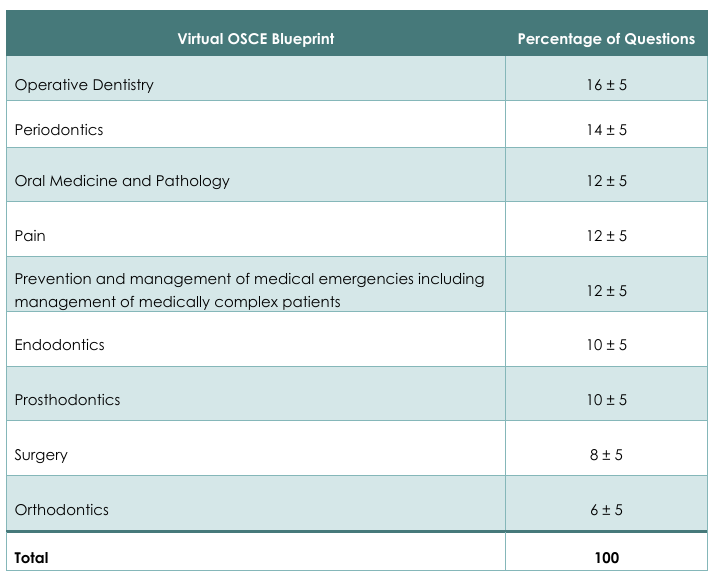
II. The Role of Question Types in the Virtual OSCE
There are 4 categories of question types as outlined in the Virtual OSCE Protocol. Approximately 50 of the 200 questions are standard single-answer multiple choice questions and the remaining case based multiple choice questions will have either a single correct answer or multiple correct answers as indicated in the question. There will also be some questions that are case based short answer questions that usually will require the candidate to write a prescription form.
It is essential to understand the importance of the different types of questions found in the Virtual OSCE. Some questions may allow the candidate to choose a single correct answer with no penalty of choosing the wrong answer while other questions may ask the candidate to choose multiple correct answers but penalize the candidate a full mark for choosing a wrong answer. More information on the types of questions and scoring system are described below.
III. Types of Questions on the Canadian Virtual OSCE
General Biomedical Questions
These types of questions are generally straightforward and are usually standard single-answer multiple-choice questions. These questions can range from head and neck anatomy to oral biology. Other topics that may appear on the question may also include dental materials, oral pathology, and medical conditions and management of these conditions. It is important to have a thorough understanding of the various disciplines of dentistry to answer these questions.
Treatment planning
A common question found in the Virtual OSCE is one that requires the candidate to formulate a treatment plan based on the information provided in the question. This information may include:
- Case History: Summarizes patient demographics, chief complaint, medical and dental history, and clinical findings.
- Periodontal Charts: Includes probing depths, bleeding on probing (BOP), clinical attachment loss (CAL), furcation involvement, recession, and tooth mobility.
- Endodontic Charts: Present information on percussion, palpation, cold and heat tests, electric pulp tests, and bite tests.
- Orthodontic Measurements: Include angular measurements such as SNA, SNB, and mandibular plane angles.
From this information, the question may ask for the most appropriate management of the chief concern.
Diagnosis and management
Developing an accurate diagnosis is also a large component of the Virtual OSCE. From the provided information in the question, candidates will be asked to formulate a diagnosis, develop a management plan, or to outline treatment considerations. The following are common topics that a candidate should be familiar with:
- Management of caries and restorative technique
- Periodontal disease diagnosis and treatment planning
- Endodontic diagnosis based on pulp vitality tests
- Oral pathologies and differential diagnoses
- Management of medically complex patients
- Recognition and treatment of dental emergencies
- Surgical extractions and complication managementOrthodontic diagnosis and treatment considerations
- Prescription writing
IV. How Answers Are Evaluated in the Virtual OSCE
Different types of questions in the OSCE will have different ways of being scored. Therefore, it is crucial to read the instructions carefully as some questions may include a penalty for choosing the wrong answer choice while others do not.
Single Answer Multiple Choice Questions
- Candidates are instructed to select the most likely or appropriate answer.
- There is no penalty for incorrect answers. Therefore, we encourage candidates to attempt all questions and avoid leaving questions unanswered.
- Example from the Virtual OSCE Protocol:
Which of the following cells participate in clot formation?
● Platelets.
○ Monocytes.
○ Lymphocytes.
○ Leukocytes.
Case-Based Single Correct Answer Questions
- These questions are clinical scenarios and may be supplemented by radiographs, charts, and patient history.
- Candidates are instructed to select one correct answer based on the information provided.
- Example from the Virtual OSCE Protocol:
Select ONE correct answer.
What is the most likely radiographic diagnosis?
● Impacted tooth.
○ Hyoid bone.
○ Torus (Tori).
○ Osteoma.
○ Sclerosing osteitis.
○ Cementoblastoma.
○ Odontoma.
○ Sialolith(s).
○ Calcified lymph node(s).
○ Calcified stylohyoid ligament.
○ Tonsillolith(s).
○ Phlebolith(s).
○ Foreign body.
Case-Based Multiple Correct Answers
- These questions require candidates to select one or more correct answers.
- The maximum score for each question is 1 and the minimum score is 0. Each answer choice has a given value.
- Partial marks may be awarded. Be aware that selecting any incorrect answer choice will result in an overall score of 0 for that question regardless of whether you have chosen other correct answers.
- Example from the Virtual OSCE Protocol:
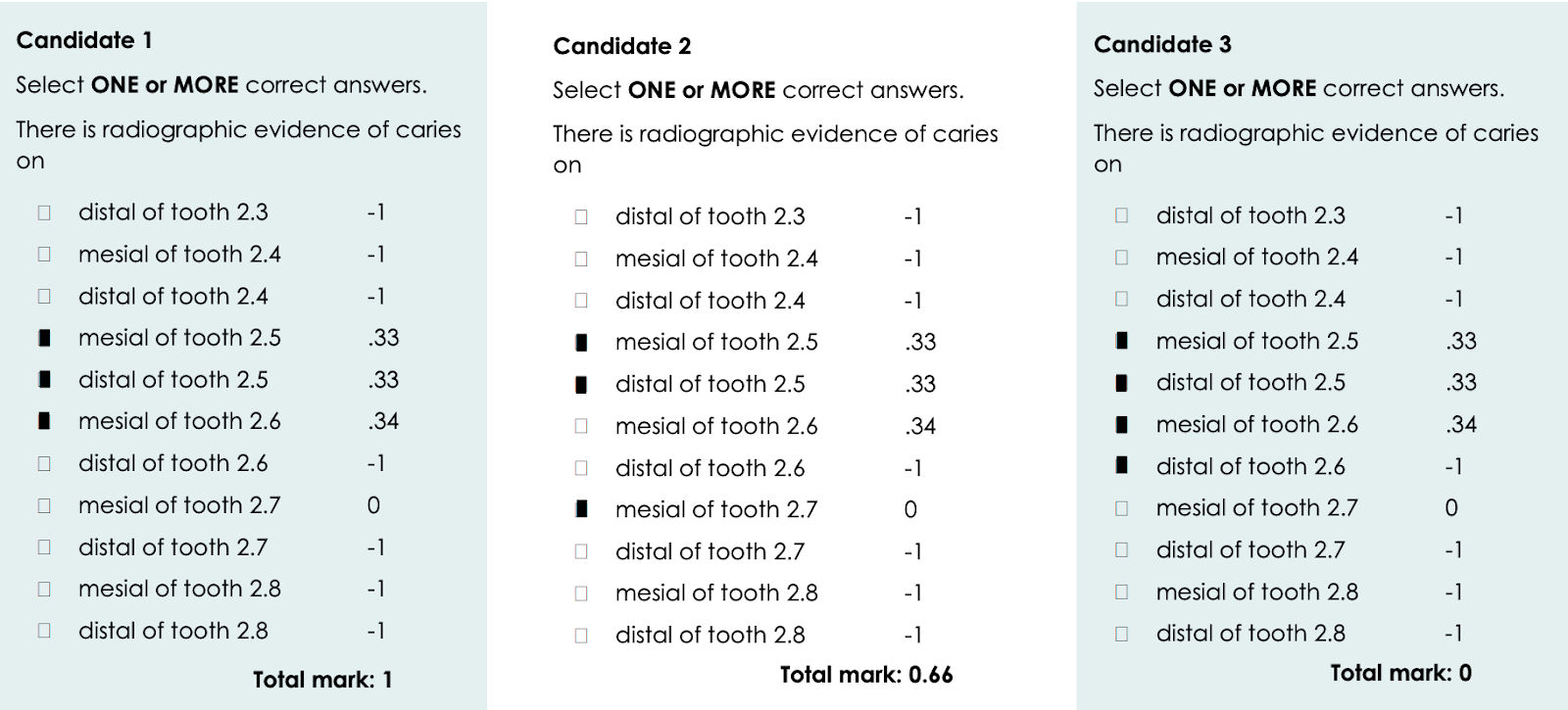
- Candidate 1 is awarded full marks for choosing all correct answer choices.
- Candidate 2 is awarded partial marks by choosing some correct answer choices but not choosing any incorrect answer choices.
- Candidate 3 receives a mark of 0 due to choosing an incorrect answer choice regardless of choosing the other correct answer choices.
Case-Based Short Answer Questions
- These questions often require the candidate to write a prescription based on the information in the clinical scenario.
- Prescription templates are provided within the examination interface.
- These questions are worth 4 marks.
- Example from the Virtual OSCE Protocol:

V: Tips for Preparing for Virtual OSCE Questions
There are several resources online to maximize your preparation for the Virtual OSCE:
- Virtual OSCE Frameworks: Be familiar with the frameworks and format of the exam as detailed above. By understanding how the questions will be presented and scored, you can be better prepared to tackle them.
- Electronic Exam Orientation: The NDEB website also provides a useful orientation guide that provides a tutorial on navigating the electronic exam format. Be sure to watch the tutorial prior to the exam so that you are familiar with navigating the computer-based exam.
- Released Questions: A released question bank from the official NDEB website is also available online for candidates to use.
- Reference texts: Recommended textbooks, clinical guidelines, and specialty organization standards used by Canadian dental faculties.
Other supporting material, such as Booster Prep, further enhance preparation by offering practice questions, mock exams, and detailed explanations that mirror the exam's structure and content.
VI. Common Mistakes in Answering Virtual OSCE Questions
A common mistake when candidates write the Virtual OSCE, is that students will take educated guesses on questions that have multiple correct answers. In these situations, it would be better to only choose the answers that you are 100% confident in as choosing an incorrect answer will result in a score of 0 regardless of whether you have chosen one of the correct answers. Therefore, being strategic with these types of questions is crucial to maximize the points awarded for each question.
However, for single answer multiple choice questions, it would be strategic to make an educated guess if you are not confident in an answer. In this case, it is better to choose an answer rather than leaving the question unanswered as there are no partial marks awarded, only a score of 0 or 1 is given for each question.
Because of the format of questions in the Virtual OSCE, it is very important that the instructions are read carefully to avoid making these mistakes.
VII. Conclusion
The Canadian Virtual OSCE is a challenging assessment that thoroughly evaluates a candidate's readiness for independent dental practice. Success requires not only mastery of dental knowledge but also the ability to apply that knowledge in various clinical scenarios. Clinical skills will be examined in an online virtual format, therefore, a systematic preparation strategy, combined with a clear understanding of the exam format is essential for achieving certification.
VIII. FAQ
Q: What is the Virtual OSCE?
A: The NDEB Canadian Virtual OSCE is a computer-based exam that assesses the competency of beginning dental practitioners about a broad range of dental knowledge. Successful completion is required to obtain a licensure to practice dentistry in Canada. It is approximately 200 questions and uses various question formats to assess the knowledge of the candidate.
Q: What types of questions are included in the Virtual OSCE?
A: The Virtual OSCE will contain 4 categories of questions. 50 questions will be single answer multiple choice questions, while the remaining questions are case-based and will either have a single correct answer or multiple correct answers. Additionally, short answer case-based questions will be on the exam and are usually based on prescription writing. Overall, the questions in the Virtual OSCE are created to assess the candidate’s ability to treatment plan, formulate a diagnosis, and provide a management plan.
Q: How should I prepare for the Virtual OSCE?
A: To prepare for the Virtual OSCE, ensure that you visit the NDEB website to familiarize yourself with the online examination platform, the OSCE blueprint and framework, and the released question bank. For further preparation, Booster Prep is a thorough and comprehensive resource that provides practice questions, mock exams, and detailed information on the various disciplines tested in the Virtual OSCE for candidates looking to achieve their NDEB certification.