
Canadian Virtual OSCE Checklist Key Topics You Must Know

I. Introduction
The Canadian Virtual OSCE (Objective Structured Clinical Examination) is a computer-based dental licensing exam intended to test the clinical judgement and dental knowledge of beginning dental practitioners or internationally trained dentists. Successful completion and NDEB (National Dental Examining Board) certification is required in order to obtain a licensure to practice dentistry in Canada. There are two parts to the exam format: single answer multiple choice questions and multiple answer multiple choice questions which will be covered later in this article. This comprehensive guide will also focus on must-know content and how to prepare efficiently for the Virtual OSCE.
II. Virtual OSCE Exam Format
The Virtual OSCE has two booklets and is written in two 3-hour parts with a 1 hour break in between each part. Each booklet contains 100 questions; about 75 questions are multiple answer multiple choice questions, otherwise known as case based questions, and 25 standard single answer multiple choice questions. Each booklet will also contain a short-answer prescription question.
It is important to understand why the exam format matters as this will impact your test taking strategy. You may even consider reviewing the electronic exam orientation on the NDEB website prior to the examination. Additionally, as you prepare for the Virtual OSCE exam, ensure that you are practicing how you pace yourself to avoid fatigue and ensuring that you are managing your time to get through all questions.
Virtual OSCE Tip: Check out this article Virtual OSCE Exam Format Explained for Canadian Candidates for more information about the Virtual OSCE Exam format.
III. Types of Questions You Must Master
As mentioned, there are two main types of questions that must be mastered for the Virtual OSCE. This section of the article will focus on how these questions will be presented to you.
Single-Answer MCQs
There will be 50 standard single-answer multiple choice questions on the Virtual OSCE. These questions may or may not be case based. Often times, these questions will assess a specific area of dentistry and you will be expected to have the knowledge or memory to answer these questions without any relevant history.
Multiple-Answer Questions
The multiple-answer multiple choice questions are case-based questions and make up the majority of the Virtual OSCE Exam. You will be presented with a patient case with relevant history such as radiographs, photos, endodontic or periodontal charts. Using the information provided to you, you will be asked questions relevant to providing a differential diagnosis, management, or other appropriate next steps.
Cases may include the following information:
- Patient demographics
- Medical histories
- Clinical photographs
- Radiographs
- Periodontal charts
- Endodontic charts
It is important to understand that these questions may have more than one correct answer. You may choose more than one answer for a maximum of one full mark or partial marks but any incorrect answer chosen will immediately score that question as zero. Therefore, it is very important to be strategic and avoid guessing answers that you are not fully confident in.
Virtual OSCE Tip: Avoid guessing on these types of questions as any wrong answer in a given question despite marking other correct answers in the same question will lose you points.
Short-Answer Questions (Prescriptions)
There will be at least one short-answer question in each booklet. These questions are prescription writing questions that require you to assess the provided patient history to provide a medical prescription based on your concluding differential diagnosis. These questions are worth four marks in total.
You may need to write adult or pediatric prescriptions for:
- Antibiotics
- Analgesics
- Antifungals
- Corticosteroids
IV. How Case-Based Questions Actually Work
As mentioned, case-based questions will typically be presented with a patient's case history with supporting clinical findings, such as photographs, radiographs, and endodontic or periodontal charts. For these types of questions, it is important to develop a strategy that will help you master these questions and become efficient.
Virtual OSCE Tip: A strategy to master these questions is to assess the clinical findings, develop a differential diagnosis, assess what the most appropriate management is, and determine what will be the next step. Using this method will allow you to develop critical decision making skills and as you practice more, you will become more efficient and prepared for exam day.
For a comprehensive guide on the Virtual OSCE, visit this article: What to Expect on the Canadian Virtual OSCE.
V. Understanding Clinical Charts and Images
Periodontal Charts
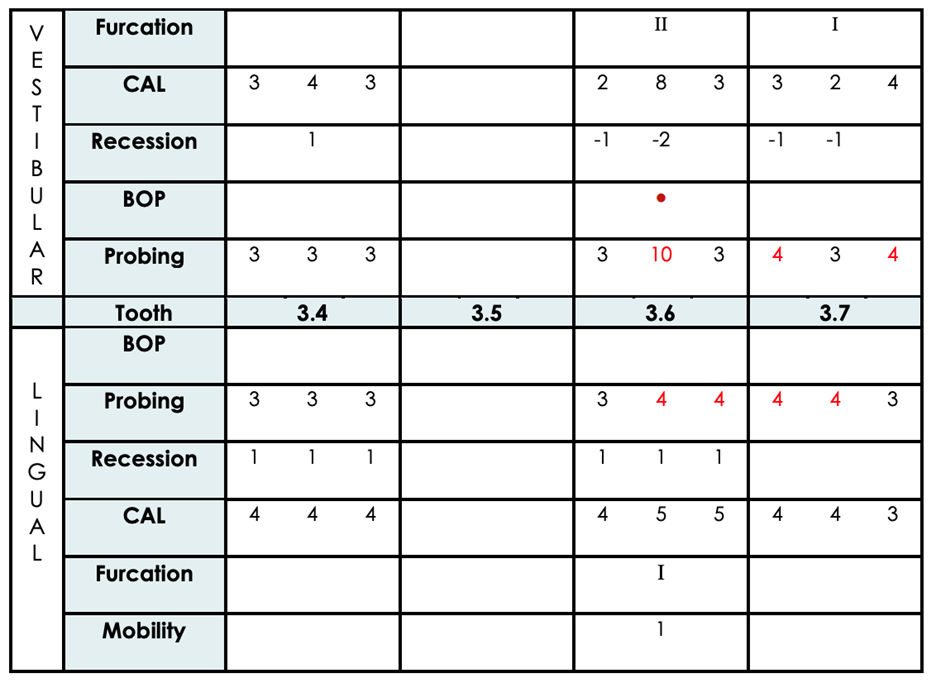
Periodontal charts may be provided to you and it is important that you understand how to read these effectively.
NDEB Virtual OSCE Protocol 2026
Note that you may only be given a sextant, like the above, or a quadrant. It is rare that you will be provided with a full periodontal chart. Missing teeth, like the 3.5 indicated in the diagram, will not have any information associated with it. From these charts, it will be indicated if the provided information is representative of the entire oral cavity and you may be expected to provide a periodontal diagnosis, staging, and grading.
Endodontic Charts
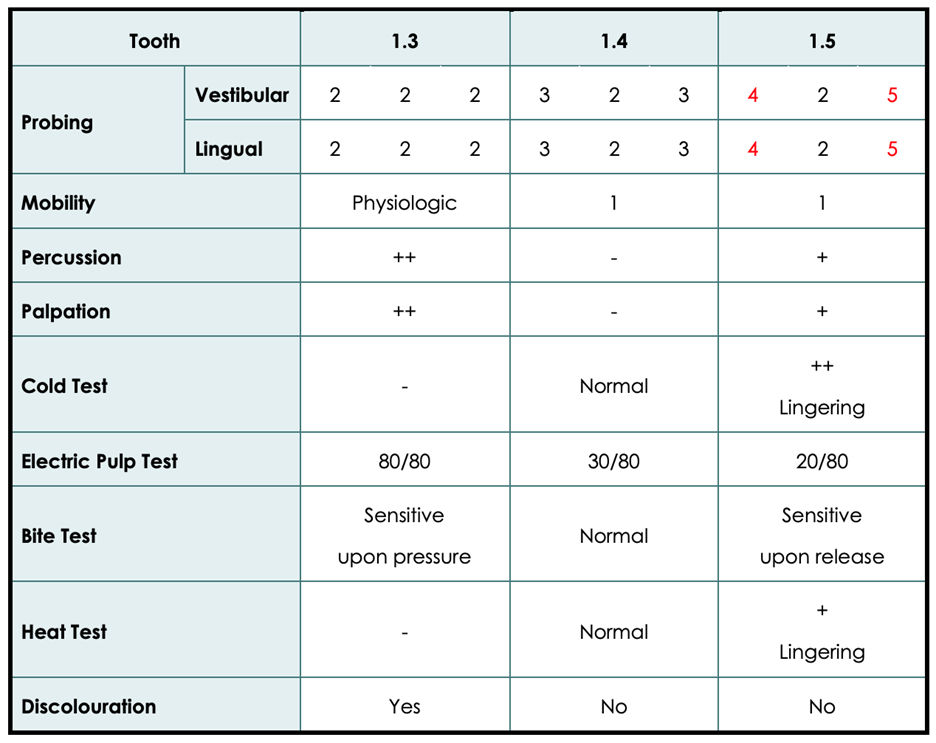
Like periodontal charts, endodontic charts may also be provided.
NDEB Virtual OSCE Protocol 2026
With endodontic charts, you may also be provided with the patient's case presentation and any relevant medical history, radiographs, and photographs. Using this information, you will likely be asked to provide an endodontic differential diagnosis and management.
Virtual OSCE Tip: Don't just rely on the endodontic chart to form a diagnosis! Make sure you use all provided information to develop a diagnosis and treatment plan.
Radiographs and Clinical Images
Radiographs and photos may also be provided to you but not all case-based questions may have these supporting images. These may be relevant to answering orthodontic questions where you may be expected to identify the malocclusion and next steps in management. Note that the zoom-in optional during exam day will be disabled and you will be expected to assess the images provided to you as presented on the screen.
VI. Virtual OSCE Scoring System Explained
For each multiple-answer multiple choice question, a maximum of 1 point can be achieved. Partial marks may also be awarded if some of the correct answers are chosen. However, any incorrect answer that is chosen for a given multiple-answer question will immediately result in a score of 0. As a result, it is important to be on the conservative side and avoid guessing answers. It is better to be awarded partial marks rather than no marks at all.
Virtual OSCE Blueprint (What You Need to Study)
According to the 2026 NDEB Virtual OSCE Blueprint, the breakdown of questions according to disciplines are as follows:
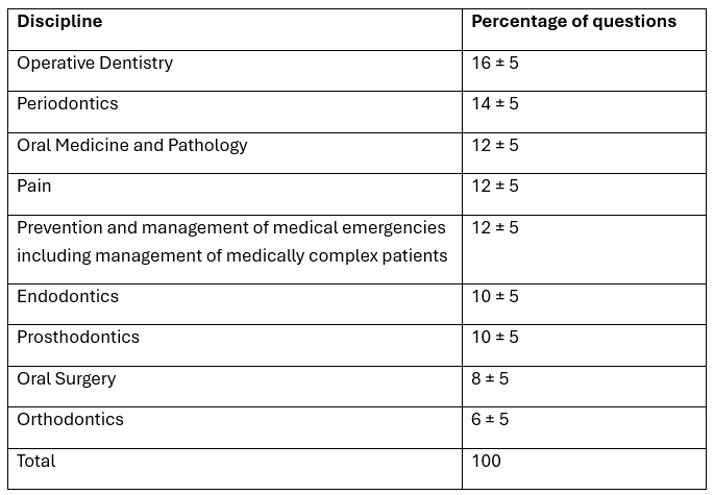
While the breakdown provided is useful in your preparation, remember that the cases presented to you will test you based on a combination of these disciplines. The questions will rarely test you in isolation so it is important that you are able to integrate your clinical findings across all disciplines of dentistry to formulate a diagnosis and determine the next steps in management. Keep this in mind as you go through your study material.
“Must-Know” Clinical Concepts for the Exam
While studying the background material for each discipline is important in your preparation, you must also develop critical thinking skills to make clinical judgements and display clinical competency during the Virtual OSCE. Because the majority of the exam is case-based, it is important to be clinically oriented in your approach to the Virtual OSCE - this means developing a strategy to assess the clinical findings provided to you to formulate a differential diagnosis and determining the most likely diagnosis. You must also know what the management should be based on your diagnosis and the next likely steps after immediate management. Overall, your mindset for preparing for this exam should be focused on assessing clinical charts and images, generating a differential diagnosis, and treatment planning.
VII. Common Mistakes That Cost You Points
1. Selecting Extra Answers
The biggest mistake that could cost you points is guessing answers on the multiple-answer questions. Be strategic and stay on the conservative side. Ensure that you are fully confident in the answer that you choose as it is better to obtain part marks than no marks at all. Don't overthink it and keep it simple!
2. Misreading Case Details
Often times, it can be overwhelming when you are trying to interpret multiple supporting materials in the case-based section. However, it is really important that you go through the findings thoroughly as there may important information about, for example, the patient's medical history that could completely change the question. Additionally, read the questions carefully! You may be asked on the management of the patient's presenting condition but immediate management versus long term management may be completely different depending on what the patient presents with.
3. Ignoring Scoring Rules
Ensure that you have a good understanding of how the Virtual OSCE is scored. Because of the formatting of the exam, you will have to understand how each type of question is scored. Make sure that you go through the scoring rules as outlined above as you prepare for the exam.
VIII. How to Prepare Efficiently for the Virtual OSCE
This section of the article will provide some tips to help you in your preparation for the exam.
- Review the NDEB Virtual OSCE frameworks: The framework provides a comprehensive list on how questions may be presented to you on the exam. It also helps you to recognize what topics you're familiar with and which ones you may need to review.
- Practicing with question banks: Your main study material should be question banks. These are crucial in your preparation as this allows you to have a better understanding on the areas that are difficult concepts and which areas you are confident in. Ensure that you are reviewing incorrect answers throughly using detailed explanations. It is also a great way to build a test taking strategy that works for you and helps to develop time management skills as you work through clinical scenarios.
Virtual OSCE Tip: Booster Prep provides multiple question banks for you to practice with and has been specifically designed to be as close to the Virtual OSCE Exam as possible.
- Improving pattern recognition: As you practice more and more with question banks, you will find that you will get better at recognizing different types of question frameworks. This will help you become more efficient at problem solving through these questions and therefore you will get faster.
- Manage your time effectively: As you identify which concepts are difficult and which concepts you are confident in, you are able to manage your time more effectively. You will know which types of questions will be easier and which questions you can afford to spend more time on.
For more information on how much time to spend studying for the Virtual OSCE, check out this article.
IX. Practice Strategy for Exam Day
Even strong candidates can underperform if they don't have a clear strategy for exam day. The Virtual OSCE is intended to test both clinical competency and decision making under timed conditions so organization and pacing are just as important as having the knowledge to write the exam.
Start with a structured approach in your problem solving. For each question, identify the chief complaint, relevant medical history, key clinical findings, and any red flags or contraindications that is provided in the patient's case history. This will help you in having a systematic approach to answering difficult clinical scenarios. We recommend using the Booster Prep approach:
- Identify the diagnosis
- Formulate a differential diagnosis
- Determine the immediate management, if needed
- Evaluate the next steps in management
- Evaluate definitive treatment options, if relevant
For short-answer prescription questions, ensure that you review and have correctly written the drug name, dosage, frequency and duration, and any refills needed. Avoid losing marks because of mistakes in writing the dosage unit, errors in instructions, or prescribing contraindicated medications. Always review the patient's allergies in the case history!
Lastly, avoid burnout by managing your time carefully as it is one of the biggest factors that affect exam day performance. Avoid spending excessive time on difficult questions early in the exam. Strong pacing includes reading the question carefully before reviewing answer choices, eliminating clearly incorrect answers, and avoiding overthinking simple cases. Practicing these strategies using question banks prior to exam day to ensure you maximize your performance.
X. Conclusion
The Canadian Virtual OSCE administered by the National Dental Examining Board is designed to assess whether you can practice dentistry safely and can act like a competent clinician in difficult clinical scenarios. Success requires a combination of dental knowledge with efficient decision making, strong interpretation skills, and effective time management.
By understanding the exam format, mastering different question types, and mastering how to interpret the supporting material provided, you can significantly improve your confidence and performance.
Preparation should focus not only on finding correct answers, but also on understanding why alternative options are incorrect. You should be using question banks to build your test taking strategy and learning time management strategies.
The Virtual OSCE can be overwhelming to study for and many use a Virtual OSCE course in their preparation. Whether you are a beginning dental practitioner graduating from a Canadian school or one of many internationally trained dentists pursuing licensure, structured preparation and consistent practice with detailed explanations with Booster Prep can make the Virtual OSCE far more manageable!
XI. FAQ
Q: Is the Virtual OSCE hard?
The Virtual OSCE is considered challenging because it tests much more than memorized knowledge of dentistry. You will be expected to interpret and have a thorough understanding of the provided clinical charts and images to formulate a diagnosis and treatment planning.
Many candidates find the exam difficult because of:
- Time pressure
- Complex case-based questions
- Multiple-answer question formats
- Prescription writing requirements
- Clinical decision-making under stress
- Ethical dilemmas
However, consistent practice with question banks often lead to major improvements in confidence and performance.
Q: How many questions are on the Virtual OSCE?
The Virtual OSCE consists of 200 questions. Each booklet contains 100 questions and 3 hours are allotted for each booklet. Typically, around 150 questions are multiple-answer questions with the remaining 50 questions as standard single-answer questions. There is usually at least one short-answer prescription question per booklet.
Q: How is the Virtual OSCE scored?
Short-answer questions usually have a total of 4 points. Each multiple-answer question has a maximum of one point and may permit partial marks. Each standard single-answer question may be awarded with one point with no partial marks awarded. The minimum score to pass is not available to the public by the NDEB and each examination day may have a different minimum score cutoff depending on the performance of candidates that exam day.
Q: How long should I prepare for the Virtual OSCE?
Preparation timelines vary depending on clinical experience, familiarity with the Canadian exam format, and overall confidence with case-based dentistry. For many success requires spending several months preparing consistently before the examination.
A strong preparation plan often includes:
- Reviewing high-yield topics daily
- Completing timed mock exams weekly and practice questions daily
- Practicing interpretation of clinical charts and images
- Reviewing prescription writing
- Studying ethics and emergency management
- Attend discussion sessions with peers or Virtual OSCE courses to get more detailed explanations on certain questions
Candidates who prepare gradually over time often retain information more effectively than those attempting to cram shortly before the exam. Consistency, repetition, and realistic practice are usually the most important factors for long-term improvement.