
The Best Anki Workflow for the DAT

Anki is an open-source flashcard software. In this article, we will discuss the best workflow to utilize the Anki app for the DAT. Anki can save over 100 hours of your time, so take this as a sign to read this article and import a DATBooster Anki deck to get the process started!
DATBooster provides free Anki decks for you to complete throughout your DAT journey; however, seeing 2,000+ new cards on day one can be intimidating. How can we utilize this great resource without getting lost and overwhelmed? This article will address that very problem by providing you with a workflow to use with Booster's complementary Anki decks from day one.
Normally, if you were to download the decks and begin doing cards while you reviewed content, you may run into the problem of doing flashcards on material completely different than the material you are reviewing. For example, you may be watching/reading lectures about photosynthesis while doing cards on taxonomy. Obviously, this is not ideal. We want to be completing the flashcards relevant to the material actively being reviewed. Fortunately, DATBooster's Anki cards are designed, through the use of tags, in a way that allows you to easily activate the cards relevant to whatever material you study on any given day. Here, I will walk you through how to take advantage of these tags to optimize your studying.
I. DAT Anki Decks Explained
What Are DAT Anki Decks?
Anki decks are digital flash cards that utilize spaced repetition and active recall to help you remember key definitions and diagrams for your DAT examination. DATBooster currently has flashcards on Biology, General Chemistry, Organic Chemistry, and Quantitative Reasoning. Keep reading this post for more information on how to setup and install Anki!
So why use Anki for the DAT? The spaced repetition is key because, instead of testing all the cards at once, Anki will space them out for you based on how difficult they were for you last time you did them. This allows you to strategically spend more time on the cards that you need to learn and less time on the cards that you already know. So create a DATBooster account and get started on Anki.
DAT Anki decks can help you with general chemistry as well as organic chemistry review. General chemistry and organic chemistry have quite a few equations that need to be memorized, and Anki's spaced repetition algorithm can help with this. For example, organic chemistry requires you to know the basic structures that are employed in reactions, and general chemistry has various formulas concerning enthalpies and reactions. DATBooster Anki decks on organic chemistry and general chemistry are incredibly high yield and will ensure you know the necessary content for test day.
II. Why Students Get Overwhelmed
Why Students Get Overwhelmed by DAT Anki Decks
The biggest struggle students have with Anki is that they will download a massive deck and immediately start studying every card in the order presented. What students do not realize is that reviews will accumulate quickly, especially if the content is new, and this becomes difficult to manage. For a video on how to set up Anki properly see here.
This is why Anki is all about consistency and having it as a supplement to your learning. Try to suspend all Anki cards and only unsuspend when you struggle with a concept or get a practice question wrong. For example, after completing a lesson on acids and bases, unsuspend only those cards instead of opening the entire gen chem deck.
After a while, you will get the hang of the process and how to decide on the correct cards to unsuspend. DAT Anki gives your studying a whole lot of meaning as you only unsuspend the types of cards you are directly struggling with and repeat them until you are no longer confused.
As an example of this, in organic chemistry, you are expected to know the various types of schemes that could be tested on the DAT. Studying the specific reactions that you do not know is possible with the DATBooster organic chemistry Anki deck. Similarly, in general chemistry, there are a multitude of schemes and various other formulas that you are required to know. Memorizing these formulas in general chemistry topics can seem incredibly daunting, but a solid spaced repetition regimen can make sure you know everything by DAT test day.
Another example of this is in biology. Biology famously has a lot of facts and information. This can range from biology facts about development and evolution to biology facts about organ systems. Because biology is so heavily memorization-based, students should attempt to focus on biology and ensure they know it really well. Biology can be a mark booster during the DAT. It is good to have the important biology facts ready to go so that when the biology section comes around and there is little time, you are ready to go!
Once you download the DAT Anki file on your computer by clicking the respective link for the topic you would like to study, we can start going in depth, whether that be on reactions, biology topics like the cytoplasm, random topics, or even the structures of the bone. This download is the first step to getting a strong mark on the DAT!
III. Tagging and Suspending Cards
I. Prerequisites
- Download all flashcards from the DATBooster site (Biology, General Chemistry, Organic Chemistry, Quantitative Reasoning)
- Add the Hierarchal Tags to your Anki Application (See my “Top 5 Free Add-ons for the DAT” article on how to do this)
II. How the Cards Are Tagged
First, let's take a look at how these cards are organized. All cards are organized based on topic. Biology cards are tagged based on DATBooster notes (available on the Biology page). For example, if you are studying Cell Organelles in the Cell & Molecular Biology notes, you would “Browse” your cards and find the cards tagged under Biology > Cell&Molecular_Biology > Cells > Organelles.
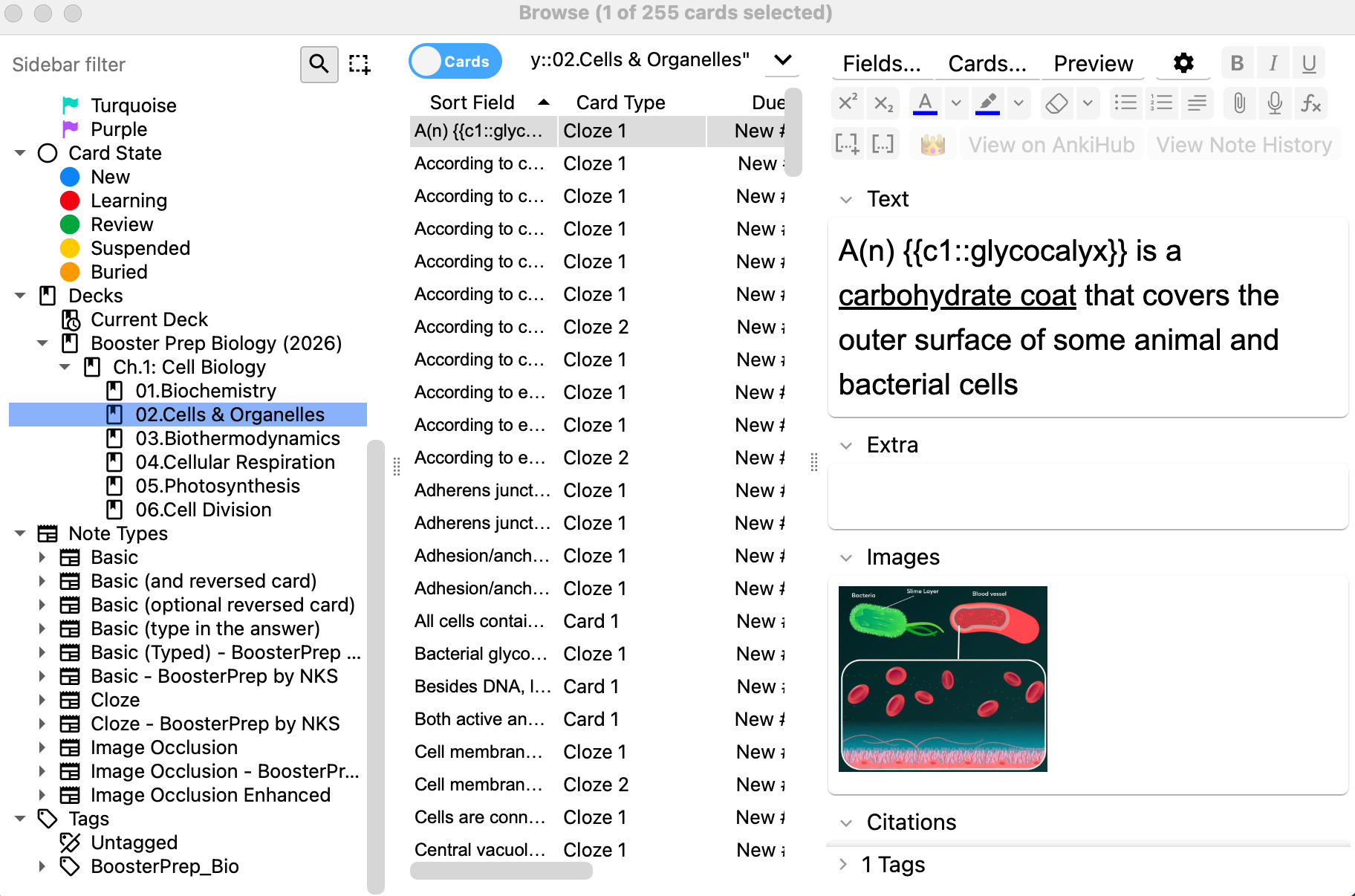
General Chemistry, Organic Chemistry and Quantitative Reasoning sections do not follow 1-for-1 the material on DATBooster in the same way as Biology but these subjects are still organized by topic and can be discovered the same way. All you have to do is find the topic that you are studying that day in the Tags.
Now that we know how to find cards on specific topics, let's go through the workflow.
III. Suspend All Cards
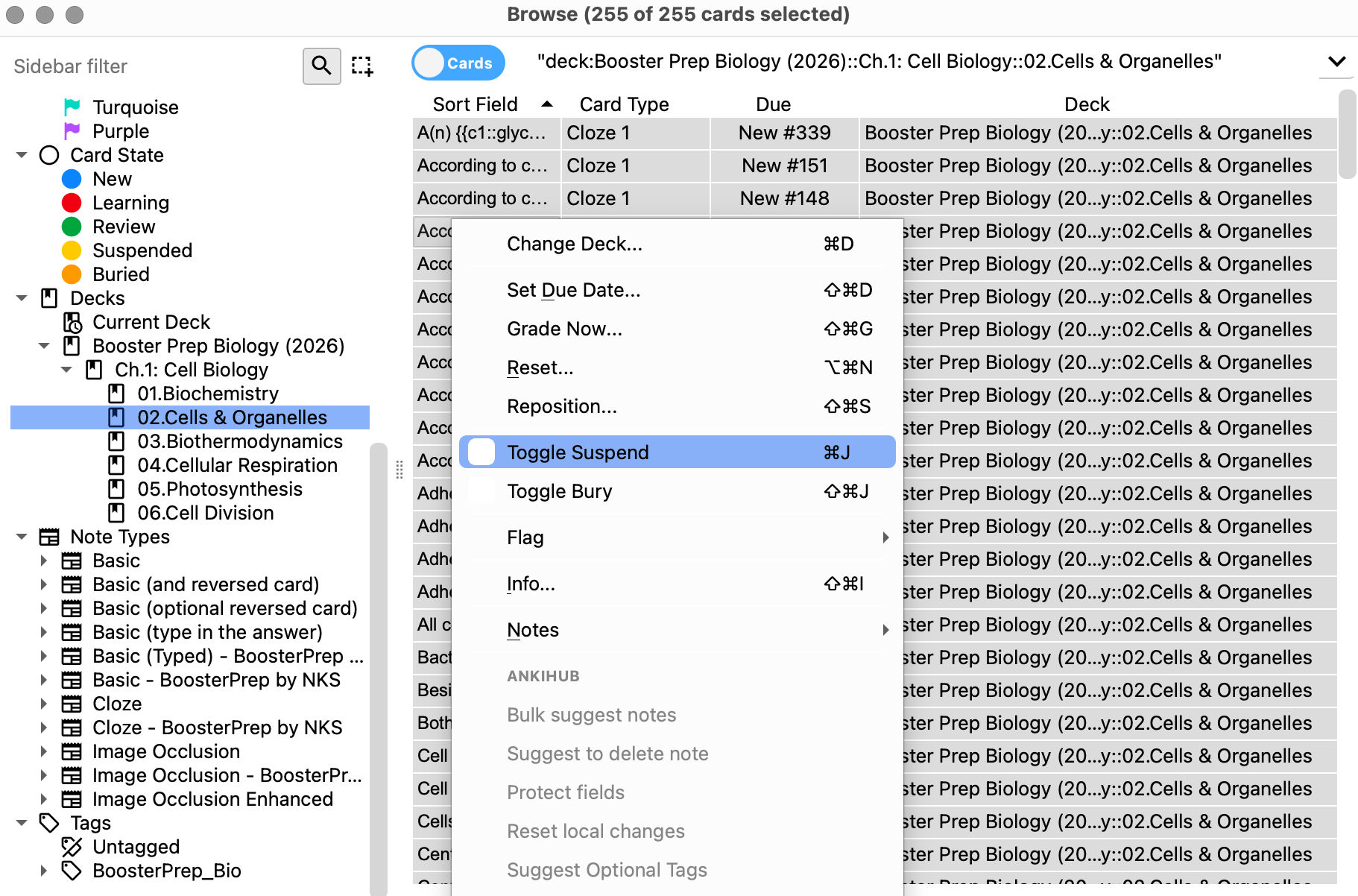
The first step for this workflow is to suspend all the cards. You can do this by going into “Browse”, clicking “Whole Collection” on the top left, highlighting all the cards (ctrl/cmd+A), right-clicking and choosing “Toggle Suspend.”
When you do this, all cards should be yellow and when you go on the main page, it should appear as if your decks are empty.
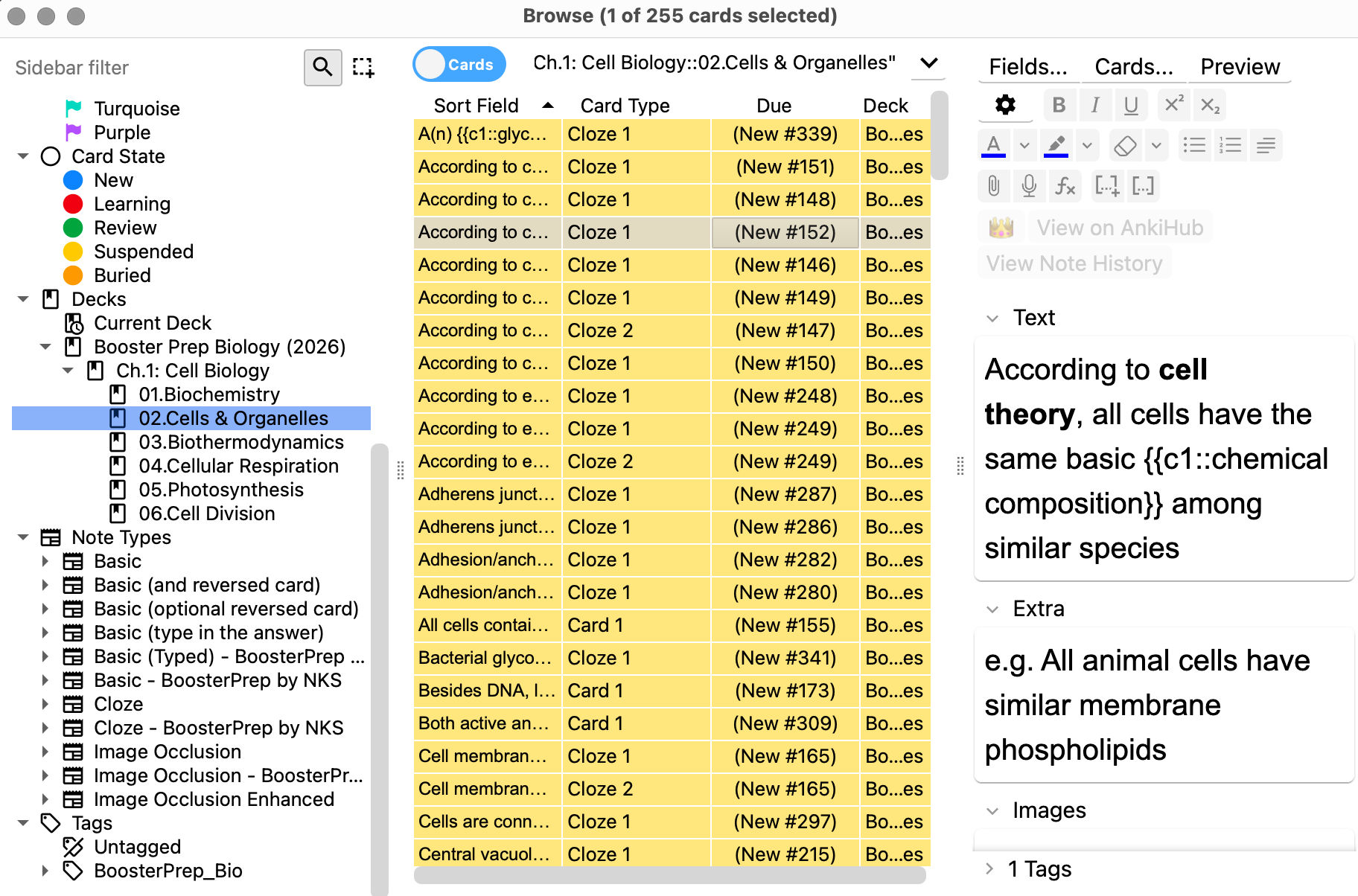

Now, we are in a situation where we can selectively unsuspend the cards relevant to our studies!
IV. Unsuspend Cards in Coordination With Review
Now that all our cards are suspended, we can now un-suspend specific cards that correspond to whatever lecture we are doing. Let’s take the example above where we just read Feralis’s notes on cell organelles. Like above, go to Biology>Cell&Molecular_Biology>Cells>Organelles and click on that tag label. Highlight all the cards, right-click and again toggle suspend.
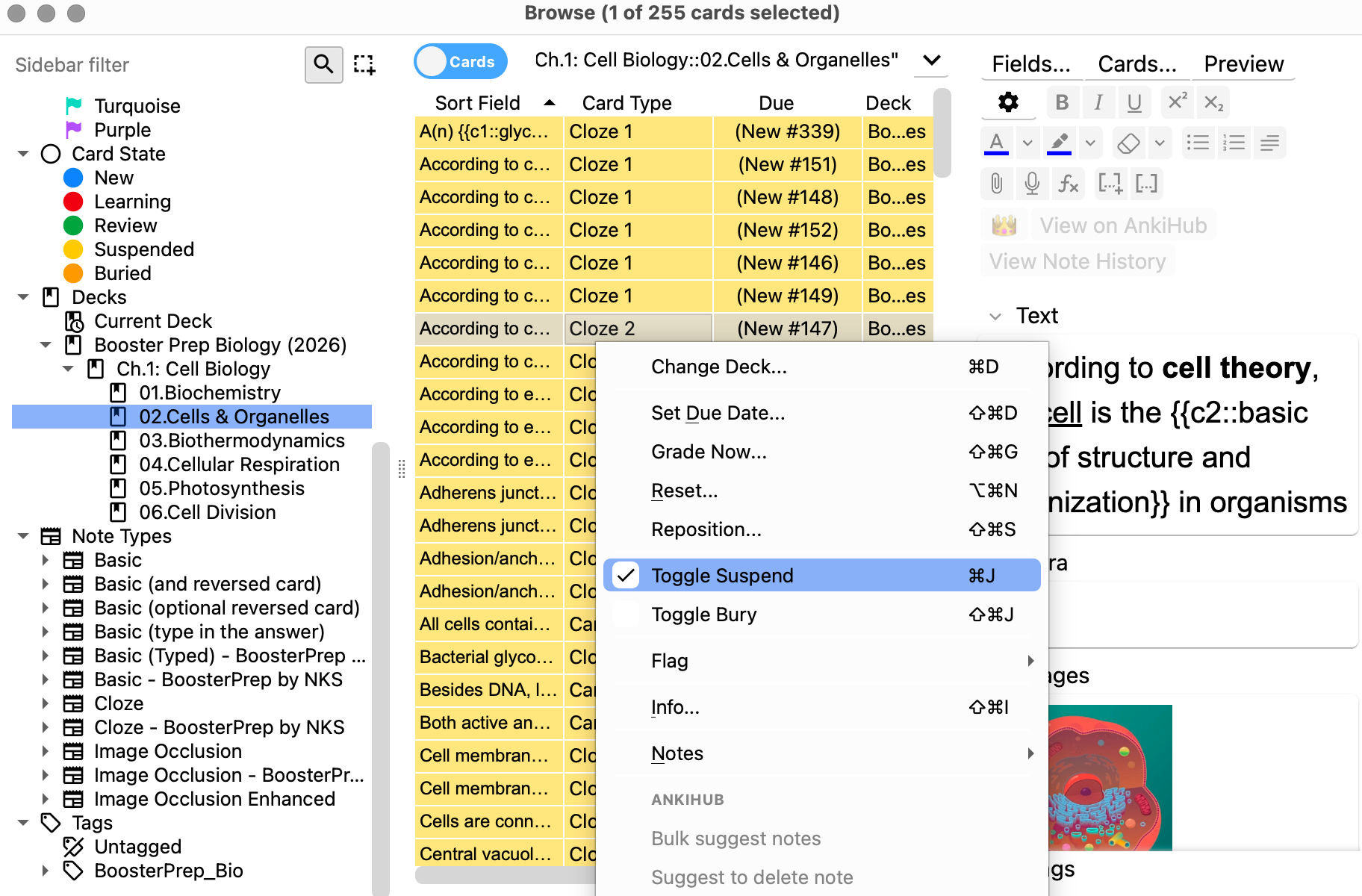
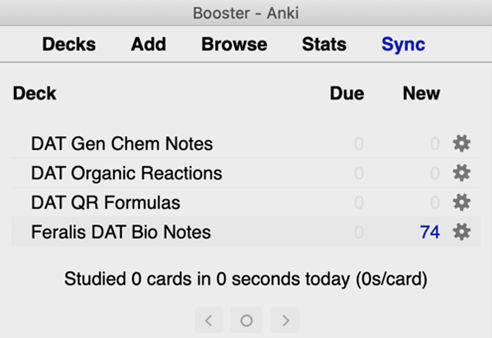
Now only those specific cards should show up on your main dashboard as New Cards!
IV. Benefits and Common Mistakes
Why Tags Make DAT Anki Decks Easier to Use
If there is one main takeaway from the tips in this article, it is that tags are arguably the most necessary part of your Anki deck studying routine for the DAT. Tags allow a massive Anki deck to become a system that can be organized into manageable chunks via searching card types. For example, filtering out biology decks to match the biology practice questions you have been doing.
Tags also allow you to filter cards by chapter, subject, or lesson. This enables you to study exactly what you missed without making your review load unmanageable day by day. Additionally, you can cross-reference Anki decks with other helpful resources such as DATBooster Daily DAT Questions, notes, and a lot of biology practice questions.
Over time, this approach creates a balanced schedule that steadily expands without becoming overwhelming while preparing for the DAT using Anki. Doing a little bit every day until the end will keep your number of reviews low and prevent similar cards from coming up again and again. Tags are the best way to keep your study schedule cool and collected without having unrelated cards occur while studying biology Anki decks.
Common Mistakes When Using DAT Anki Decks
There are many habits that will reduce the effectiveness of Anki. Some of these mistakes include activating too many new cards in Anki decks, unsuspending every card, not being consistent with daily reviews, or using Anki before learning the material. And of course, the biggest one, not using tags to organize your Anki deck studying. Avoiding these mistakes helps keep your Anki deck workload sustainable throughout your DAT preparation.
Having an interruption because you are tired, lost focus, or because you eventually missed a day can happen, but it is important to keep up with both review and new cards. Doing a small number of new cards every day will ensure you are not burnt out from Anki decks. As an example, doing 20 new cards a day will result in 150-200 review cards in no time. And this is only for one Anki deck.
The bottom line is that doing Anki decks in a manageable amount, whether they are on the computer or phone, is important. Reviews occur more frequently than you would expect, and any new Anki deck cards you import will only make the review load worse. You will find that after a while of doing bio or general chemistry cards, your DAT practice exam marks will increase, and you will find some organization in your study routine. For more information on how to improve DAT scores, check out the link!
V. Final Thoughts
Final Thoughts on the Best DAT Anki Workflow
So, in conclusion, Anki decks are most effective when they are used alongside your DATBooster study plan rather than as a standalone resource to learn the material. If you are able to suspend cards from Anki decks based on the lesson plan and review cards based on the concepts that need work, then you will create a workflow that will allow for long-term retention. This will also prevent you from getting buried in workload from Anki DAT decks on random topics.
Make sure to do practice questions alongside Anki decks, as practice questions are an incredibly high-yield way to learn. For example, say you are studying the cell and doing the respective biology cards from the Anki deck. The deck will only test content in a specific way. Practice questions test the same content as the deck but in a manner similar to the exam. Check out this post for more on these topics.
Following this approach allows you to stay consistent, keep review sessions manageable, and make steady progress throughout your DAT preparation. Supplement the Anki decks with other downloaded notes and resources, and you are good to go! Congrats on creating your DAT Booster account and starting the download on those DAT bio topic decks!
VI. FAQ
Q: What are DAT Anki decks?
A: Anki decks are collections of digital flashcards designed to help students memorize and retain information through spaced repetition. They cover the major subjects such as general chemistry, organic chemistry, and biology tested on the DAT and are best used alongside content studying.
Q: Do I need to suspend all DAT Anki cards at once?
A: Absolutely! Suspending all cards initially allows you to gradually activate material as you study, preventing an unmanageable review workload. For example, if you are studying biology, you may unsuspend the biology cards only.
Q:Why are tags important in DAT Anki decks?
A: Tags organize cards by subject or chapter, making it easy to review only the material you've recently learned instead of searching through the entire deck. For example, un-suspending based on practice questions you have done.
Q: How often should I review DAT Anki decks?
A: Follow the scheduler! Anki's spaced repetition scheduler will automatically tell you which cards are due for that day.